For years, the single strongest argument against automating tray loading has been rigidity. An automatic tray loader — the reasoning went — only pays off when it runs a standardized product in high volumes with tight tolerances. The moment formats change, reconfiguration time erases the productivity gain, and the comparison with manual operators swings back in their favor.
That objection has lost most of its weight, thanks to one specific engineering evolution: the pick head with mechanical cam adjustment. It’s the solution LinePack integrates into its flagship tray loader, and it’s the reason why tray loading automation today makes economic sense even in production environments with high format variability — from cosmetics to pharmaceutical, from premium packaged food to industrial tubes.
In this article we break down how the system works, what concrete advantages it delivers over manual and conventional automated tray loading, and in which production contexts a multi-format automatic tray loader represents the fastest-payback investment.
What a Tray Loader Does in Secondary Packaging
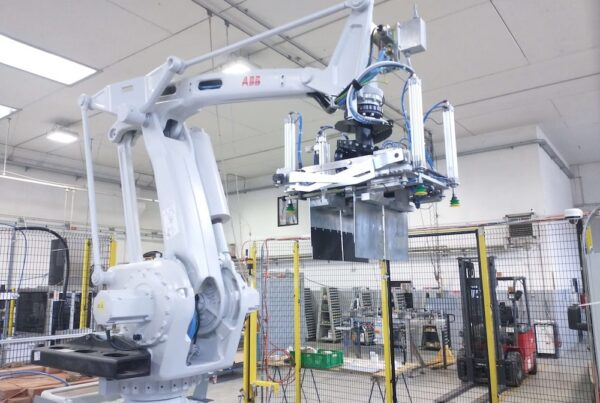
A tray loader is the machine that collects finished products exiting the primary line and arranges them neatly inside trays, cartons, or display units. It sits in the secondary packaging phase — the intermediate step between individual product packaging and final palletizing.
In modern manufacturing, tray loading is one of the most common bottlenecks on the line. The reason is structural: primary packaging (filling, sealing, labeling) is almost always automated and runs at high cadence, while tray loading in many plants remains a manual, labor-intensive operation — with significant implications in terms of labor cost, operational continuity, ergonomics, and finished-product quality.
An automatic tray loader removes this bottleneck by working on four dimensions simultaneously: speed, consistency, placement accuracy, and repeatability. But for the investment to be truly sustainable, the machine has to handle the real-world variability of production — and this is where cam-adjusted pick head technology becomes decisive.
The Core of Flexibility: The Cam-Adjusted Pick Head
The pick head is the component of the tray loader that makes direct contact with the product: it grips the product from the conveyor, lifts it, and places it inside the tray. In conventional solutions, the pick head is sized for a specific format: when the product changes, the head changes too, with all the downtime and cost that implies.
Our tray loader takes a radically different approach. The pick head is equipped with a mechanical cam adjustment system that allows the grippers or pickups to expand and contract according to the dimensions of the product being handled. The motion is driven by a cam profile engineered to cover a predefined dimensional range, and the adjustment is deterministic, repeatable, and fast.
In practical terms, this means the same machine can work — without component replacement and without complex manual setup — across a broad range of different formats. Changeover becomes a parametric adjustment, not a structural mechanical intervention.
Four Operational Advantages of the Multi-Format Tray Loader
1. Fast Changeover Without Prolonged Line Downtime
In traditional systems, changeover involves disassembling and reassembling mechanical components, with times that often exceed one hour per transition. In a multi-SKU production environment, this means accumulating several hours of unproductive line time over the course of a single week.
With the cam-adjusted head, reconfiguration takes minutes. The operator selects the format from the control panel, the system recalls the stored parameters, the cam repositions to the new profile. The result is operational flexibility that makes automation economically viable even for manufacturers with wide product catalogs and medium-sized batches.
2. One Machine for Multiple Product Lines
Historically, secondary packaging automation has forced a binary choice: buy a rigid machine dedicated to one high-volume format, or keep tray loading manual to handle the production mix. This trade-off is especially painful in high-variety industries — cosmetics, pharmaceutical, premium food — where the product portfolio can include dozens of SKUs with different formats.
The multi-format tray loader eliminates that choice. A single machine handles the full portfolio, with consolidated capital expenditure rather than investment spread across multiple dedicated lines. For the plant manager, this translates into reduced production footprint, simpler maintenance, and streamlined spare-parts management.
3. Consistent Cadence Across the Entire Shift
Manual tray loading is one of the operations most subject to physiological productivity drops over the course of a shift. Repetitive lifting, precise placement, and the concentration required to maintain tray order lead to progressive fatigue that shows up in hourly cadence and error rates.
An automated system holds nominal cadence from the first minute to the last, regardless of shift length, plant temperature, or time of day. This consistency has a direct impact on effective throughput — which is often significantly higher than a simple comparison of theoretical manual vs. theoretical automatic cadence would suggest.
4. Scalability Without Proportional Headcount Growth
When demand rises and a company needs to expand capacity, traditional options are two: add shifts or hire more operators for the tray loading line. Both paths have structural limits: the industrial labor market is increasingly tight, especially for ergonomically demanding roles, and adding shifts brings organizational complexity and rising cost.
Automation enables linear capacity scalability: extend the line, add modules, increase speed — without proportional growth in dedicated headcount. For companies in expansion phase or operating in markets with strong seasonal demand, this scalability is often the decisive factor in the investment decision.
When an Automatic Tray Loader Is the Right Choice (and When It Isn’t)
It’s fair to say that automation isn’t always the better answer. An automatic tray loader delivers its full potential when the upstream process is stable, well-defined, and operates within controlled dimensional tolerances. In chaotic production environments, with frequent out-of-spec products or deformed cartons, human adaptive flexibility remains difficult to replicate — even by the best automated system.
The real critical point in any tray loading automation project is therefore not the machine itself, but the maturity of the production process feeding it. Before evaluating the investment, it’s essential to analyze upstream flow stability, product dimensional consistency, and the quality of incoming cartons or trays.
As a technical partner, LinePack approaches every project starting from this preliminary analysis: it’s the only way to ensure that the delivered solution generates the ROI the customer expects.
Application Sectors: Where Our Tray Loader Makes the Difference
LinePack’s multi-format tray loader finds optimal application in all production contexts characterized by wide product ranges, high cadences, and strong attention to ergonomics. Among the most frequently served sectors:
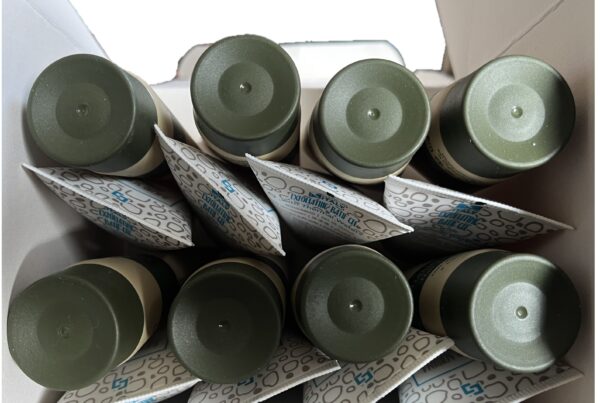
The cosmetics and personal care industry, where format variety — tubes, bottles, jars, sticks — and frequent introduction of new lines make changeover flexibility critical. The pharmaceutical and OTC sector, where flexibility combines with traceability requirements, placement repeatability, and process validation. Premium packaged food, with medium batch sizes, seasonality, and differentiated secondary packaging. The home care and industrial adhesives industries, where handling unstable products or irregular geometries has historically represented a barrier to automation — a barrier that our adaptive pick heads have now removed.
LinePack’s Tray Loader in Action at Interpack 2026
The machine described in this article is the same one we will present live at our Interpack 2026 stand, the world’s leading trade fair for the packaging industry, taking place in Düsseldorf from May 4 to May 10, 2026.
At Hall 16 – Stand A67 you will be able to observe the cam-adjusted pick head in operation, watch a real-time changeover, and discuss with our technical team the feasibility of integrating the solution into your specific production line. For anyone working in secondary packaging, Interpack is the most concrete opportunity of the year to evaluate technologies in action and compare different solutions directly.
To book a dedicated meeting with our team, contact us through www.linepack.it or reach out directly. We will be glad to arrange a personalized demo tailored to your reference formats.
Frequently Asked Questions About the Multi-Format Automatic Tray Loader
How many different formats can a cam-adjusted tray loader handle?
The number of manageable formats depends on the dimensional range covered by the cam profile engineered for the specific application. In LinePack’s most common configurations, a single cam-adjusted pick head can easily handle 8–15 different formats within the same dimensional range, with changeover times in the order of minutes.
How long does a format changeover take on your tray loader?
With the cam system and pre-stored parameters in the control panel, changeover typically completes in 5–15 minutes, compared to the hours required by traditional systems that involve physical replacement of the pick-head components.
Is an automatic tray loader suitable for small batch sizes as well?
Yes. The speed of changeover is precisely what makes the multi-format tray loader competitive even on medium and small batches, where rigid conventional systems would not be economically justifiable.
What types of products can the cam-adjusted pick head handle?
LinePack has developed deep specialization in handling complex and unstable products: cosmetic tubes, bottles, jars, creams, industrial adhesives, and pharmaceutical items. The cam-adjusted head adapts to cylindrical, rectangular, and mixed geometries, following analysis of the specific product.
Where is LinePack machinery manufactured?
All our machines — including tray loaders, case packers, wraparound systems, and palletizing solutions — are designed and built at our facility in Fontevivo (Parma, Italy), with over 15 years of experience in secondary packaging and end-of-line automation.
How can I evaluate whether an automatic tray loader is suitable for my production line?
The most effective path is a preliminary technical consultation in which we analyze your production mix, upstream process stability, volumes, and target cadences. You can contact us through www.linepack.it or visit us at Interpack 2026 – Hall 16, Stand A67, from May 7 to May 13, 2026.