
The logistics bottleneck and the need for automation
In any manufacturing plant the palletizing phase represents the final and most crucial moment of the entire production cycle. After products have been accurately dosed, sealed and placed into their respective secondary packaging such as boxes or shrink wrapped bundles, they must be arranged in an orderly and stable manner on a wooden or plastic pallet to be stored in the warehouse or shipped. If this operation is entrusted to manual labor it inevitably turns into a severe logistics bottleneck. Operators are forced to lift and position hundreds of heavy loads every day, a highly repetitive activity that drastically lowers the hourly efficiency of the plant and exposes staff to serious risks of physical injury and fatigue.
To overcome these problems and ensure an uninterrupted workflow the most competitive companies are integrating robotic palletizing islands into their lines. The introduction of an intelligent mechanical arm at the end of the production path radically changes the dynamics of the factory. The machine knows no fatigue, maintains a constant operating pace for entire work shifts and ensures that every single package is deposited on the pallet with millimeter precision, creating perfect and incredibly stable geometric compositions.
The versatility of robotics compared to traditional systems
When deciding to automate product stacking the choice often falls between classic Cartesian layer palletizers and more modern anthropomorphic robots. Although traditional systems are valid for very linear and high speed operations, anthropomorphic robots offer an absolutely unequaled level of operational flexibility.
These robotic arms, typically structured on four or six axes of movement, are able to replicate and exceed the agility of the human arm. Their main advantage lies in their ability to operate in extremely restricted and complex workspaces. Unlike large gantry machines that require fixed and bulky footprints, a robot can be installed in the center of a compact area and simultaneously manage the flow of products coming from two or more different packaging lines. The arm can rotate on itself, pick up a box from a conveyor belt on the right, rotate again and place it gently on one of the multiple pallets being formed on its left, thus optimizing the company floor plans in an extraordinary way.
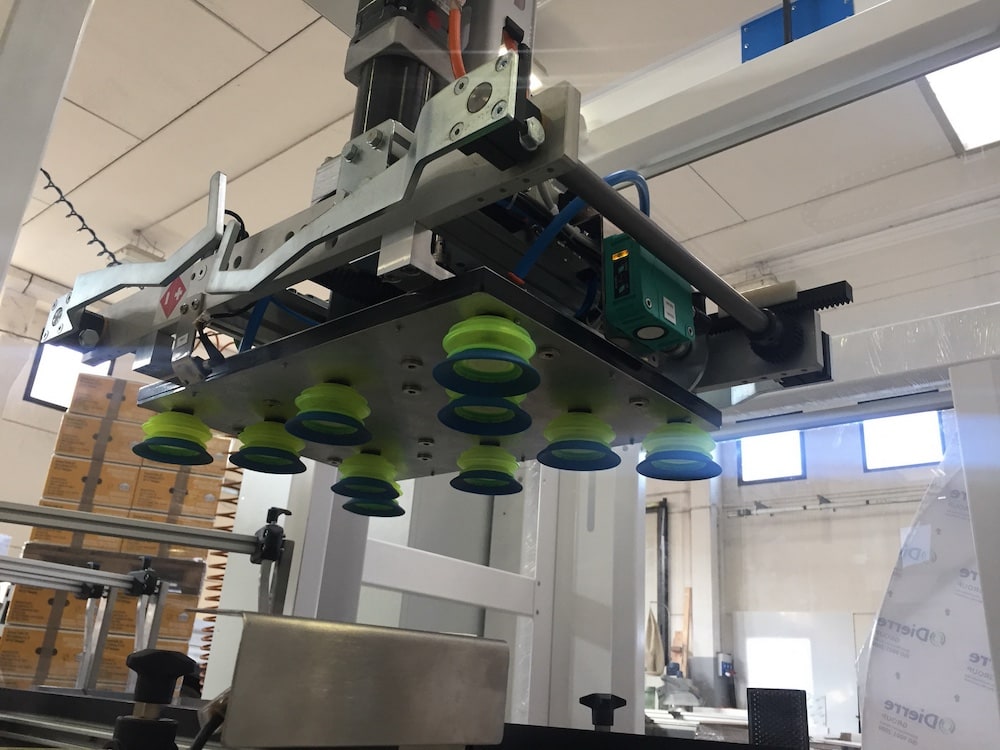
Gripper heads custom designed for every product
The real secret that determines the success of a palletizing island does not lie solely in the brute force or speed of the robotic arm, but in the engineering of its end of arm tooling. Every industrial sector presents unique handling challenges. A flexible flour bag behaves very differently compared to a solid corrugated cardboard box or a bundle of bottles wrapped in thin film.
For this reason we do not use standardized equipment but rather we design highly customized gripper heads based on the physical characteristics of the customer product. If the line produces fragile cardboard boxes the robot is equipped with vacuum plates and suction cups that lift the package from above without crushing it. In the case of heavy or irregular bags robust mechanical grippers or pneumatically driven forks are installed to firmly embrace the load from below, preventing any risk of falls or product breakage. Many of these gripping tools are also multifunctional. This means that the robot can use the same tool not only to move the product but also to autonomously pick up an empty pallet from the reserve stack and to insert cardboard slip sheets between one layer and another, completely eliminating the need for human intervention within the safety perimeter.
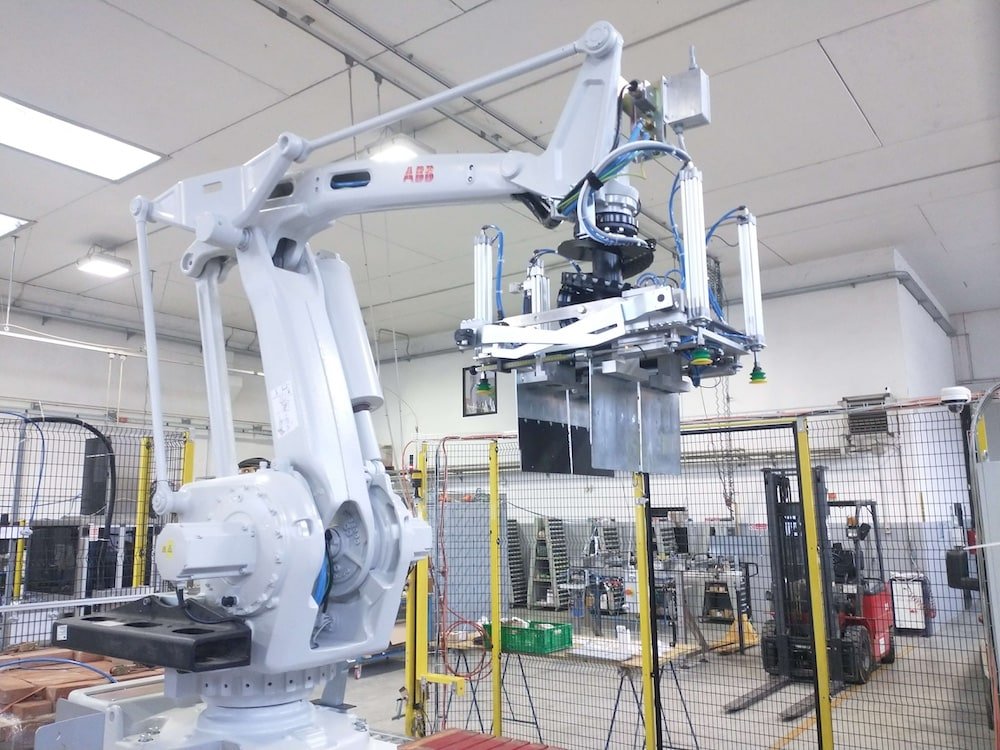
Intelligent safety and intuitive control software
The integration of such powerful machinery requires strict compliance with international safety standards. Our robotic islands are designed to guarantee the total safety of the personnel. The work perimeter is delimited by physical fences and safety light curtains connected directly to the emergency stop circuits. If an operator accidentally crosses the safety threshold during operation the sensors detect the human presence and instantly block all mechanical movements in fractions of a second.
Another fundamental aspect concerns the interaction between man and machine. In the modern industrial landscape companies must frequently change the format of their packages or create new stacking patterns to meet the strict demands of large scale retail distribution. To avoid having to call a specialized software engineer every time a new product is introduced, our systems are equipped with extremely intuitive software interfaces accessible from practical touch screens. Through these control panels the line manager can create, save and recall new palletizing recipes in a visual and simplified way. The intelligence on board the machine automatically calculates the best trajectories to avoid collisions, ensuring quick production restarts without any operational hitches.

